Spatial design: Turning architecture into a spaceship
A letter from a spatial designer
Do you like spaceships? Many of us do. But how many of us have actually been on one? Or better yet, on the ESS Odysseus?
The ESS Odysseus spaceship is an old military vessel, converted to carry out interplanetary science missions. The vessel is like a small society of its own, with its own Med Bay, Science Lab, Engine Room, Mess Hall and canteen, Crew Bar, and a Hangar Bay with smaller fighter jets, and many more areas. It also has its own armory and marine corps, who are deployed on missions to different planets. The players get to live aboard the vessel as its crew. As someone once described it: “This is everything the Disney Galactic Starcruiser could never have been.”
In 2019 and again in 2024, the ESS Odysseus spaceship was built inside a 2000 square meter school building by an amazing group of volunteers. The 2024 version brought together 18 designers, ranging from highly skilled DIY larpers to professional theatre set designers. During construction, between 20 and 50 people worked on site each day. The entire spaceship was built in just two and a half weeks, and after the event it was taken down within three days. It was an immense undertaking and a truly unique experience. Even more than that, it was an act of dedication and love.
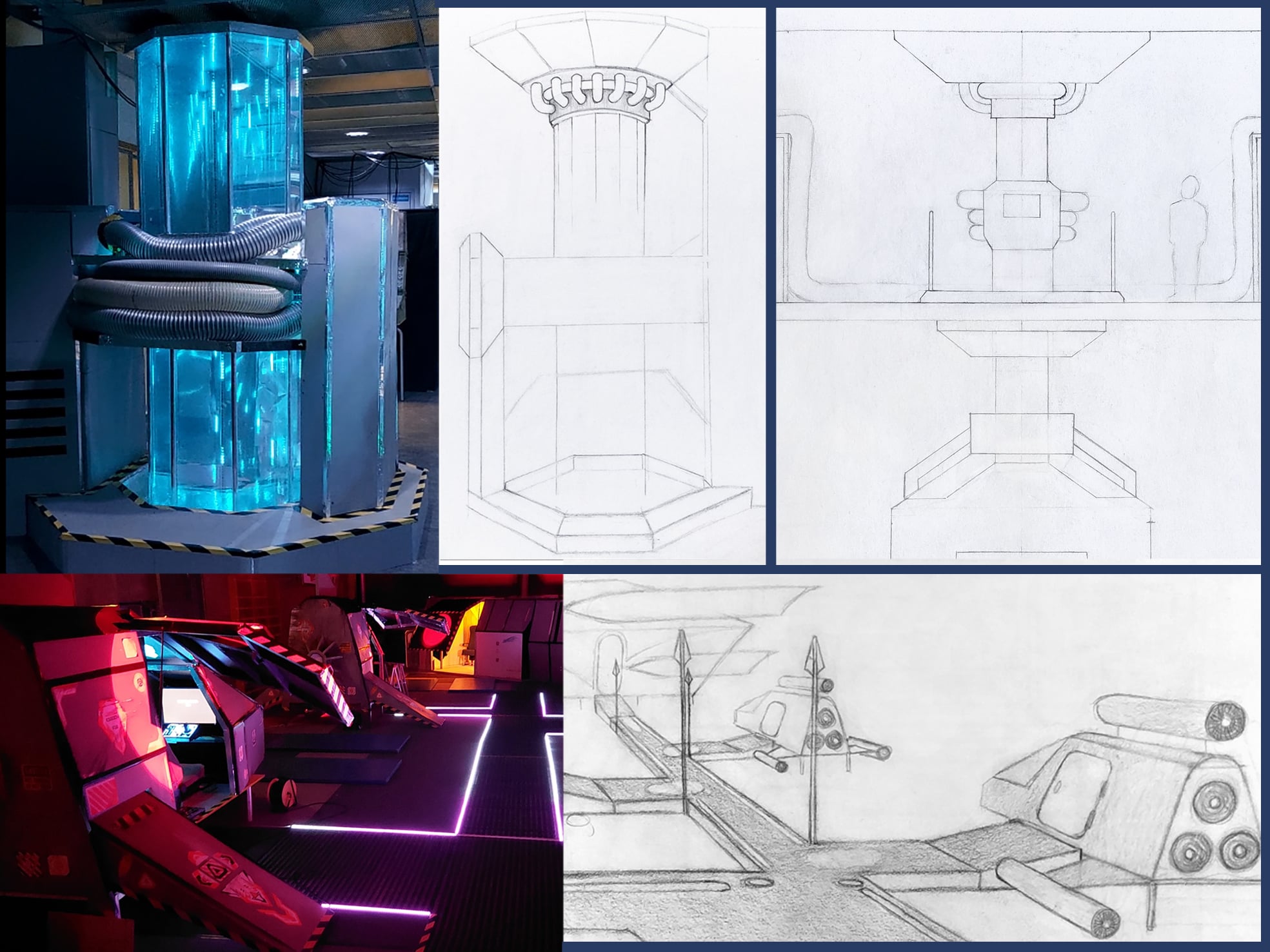
2024 - From first sketches to finished elements. Pictures: Carita Laajisto
Odysseus 2024 - experience of designing temporary
In 2024, I was one of the designers, a theatre set designer with experience on designing escape room- horror houses, responsible for the Engine Room, Jump Engine, Hangar Bay, Fighter Jets, Starcaller, Mess Hall and the Crew Bar. Many players especially connected with the Engine Room, and the response to all of the areas has stayed with me. For the upcoming 2026 spaceship, if the crowdfunding campaign succeeds, I am now designing the entire vessel as a spatial designer and scenographer.
Looking back at the 2024 vessel, I carry with me a deep appreciation for the intensity and atmosphere we were able to create in a very limited timeframe. The Engine Room, in particular, resonated strongly with people because of its layered and engaging environment, anchored by clear focal points that structured the interaction. It demonstrated how spatial richness and clarity can coexist, even in a dense setting. With the new vessel, I carry forward that understanding of focal clarity and layered design, while applying it with greater variation in scale, openness and circulation.
In 2019 and 2024 the school building, being a temporary venue, brought its own design challenges. Everything had to be free-standing, without attaching any structures to the building itself. With a limited construction period, these restrictions often led to creative solutions during the build. The Jump Engine, for example, had to be designed around one of the bulky coat racks fixed in the school corridor. There was also some frustration about the painted bear footprints on the floor that we couldn’t cover. In the end, the blue ambient lighting of the space did a surprisingly good job of softening them, and they became barely noticeable.
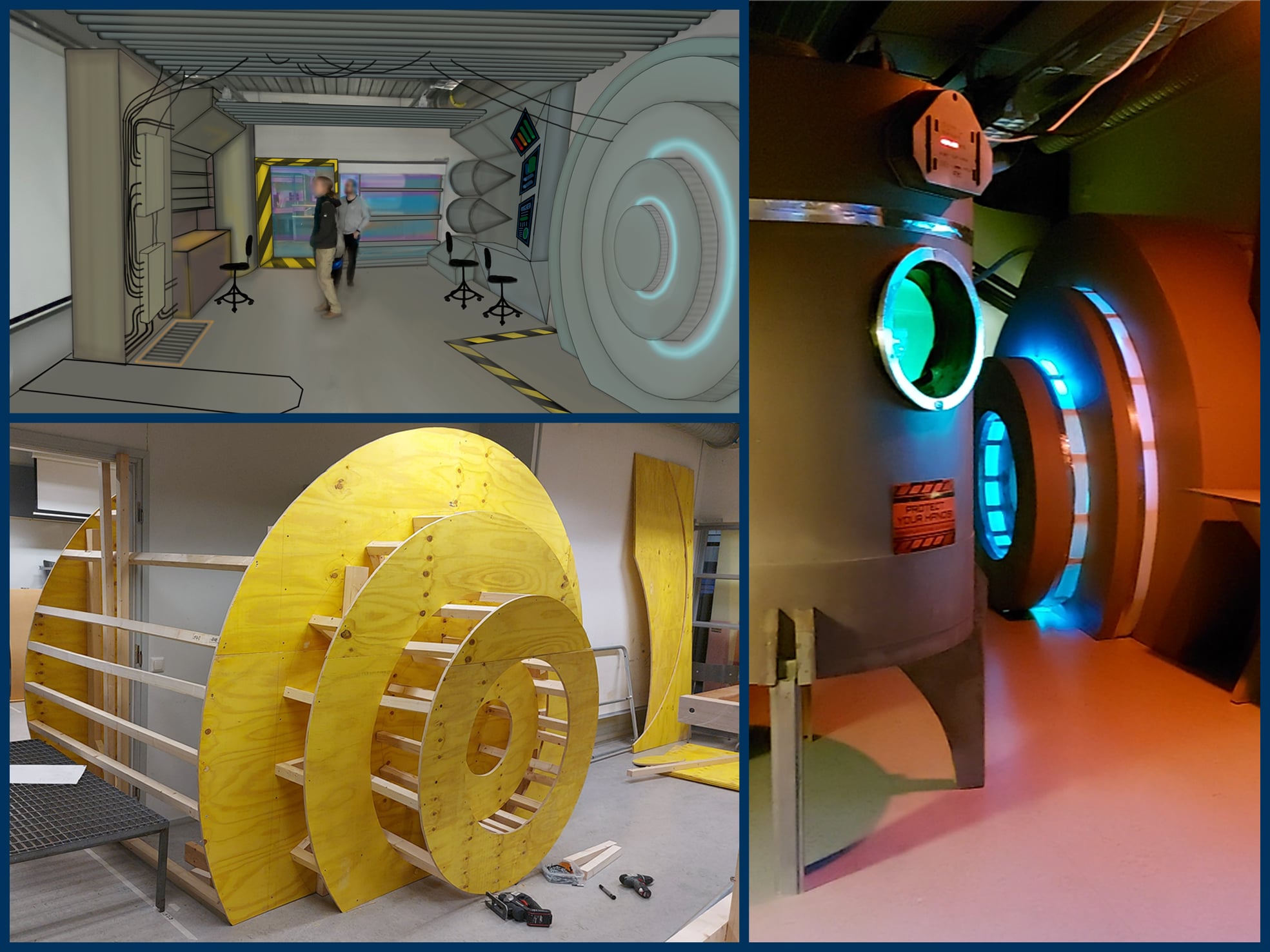
2024 - Phases: Design - building - experience. Pictures: Carita Laajisto
Next: Refinement from experience, long term from potential
This time we are able to schedule a proper construction period, allowing for more refinement, structural durability, detailing and long-term reliability. Every space is being redesigned with gameplay depth, functionality and long-term use in mind. Some planned areas will be entirely new, including dedicated marines’ and pilots’ training quarters, expanding the ship beyond anything we have built before.
While the 2024 vessel was a multi-functional system with different departments, I plan to take the ship’s overall design further by making it more internally logical so the vessel functions as a closed-loop ecological system, where life support, energy and daily life form a continuous cycle rather than separate spaces. One of the aspects where this will become visible to the players, is the Green Room. While the 2024 Green room was a nature filled oasis in the vessel, the new Green Room will be an oasis, but also visually presenting as a more crucial life support system producing food as well as oxygen.
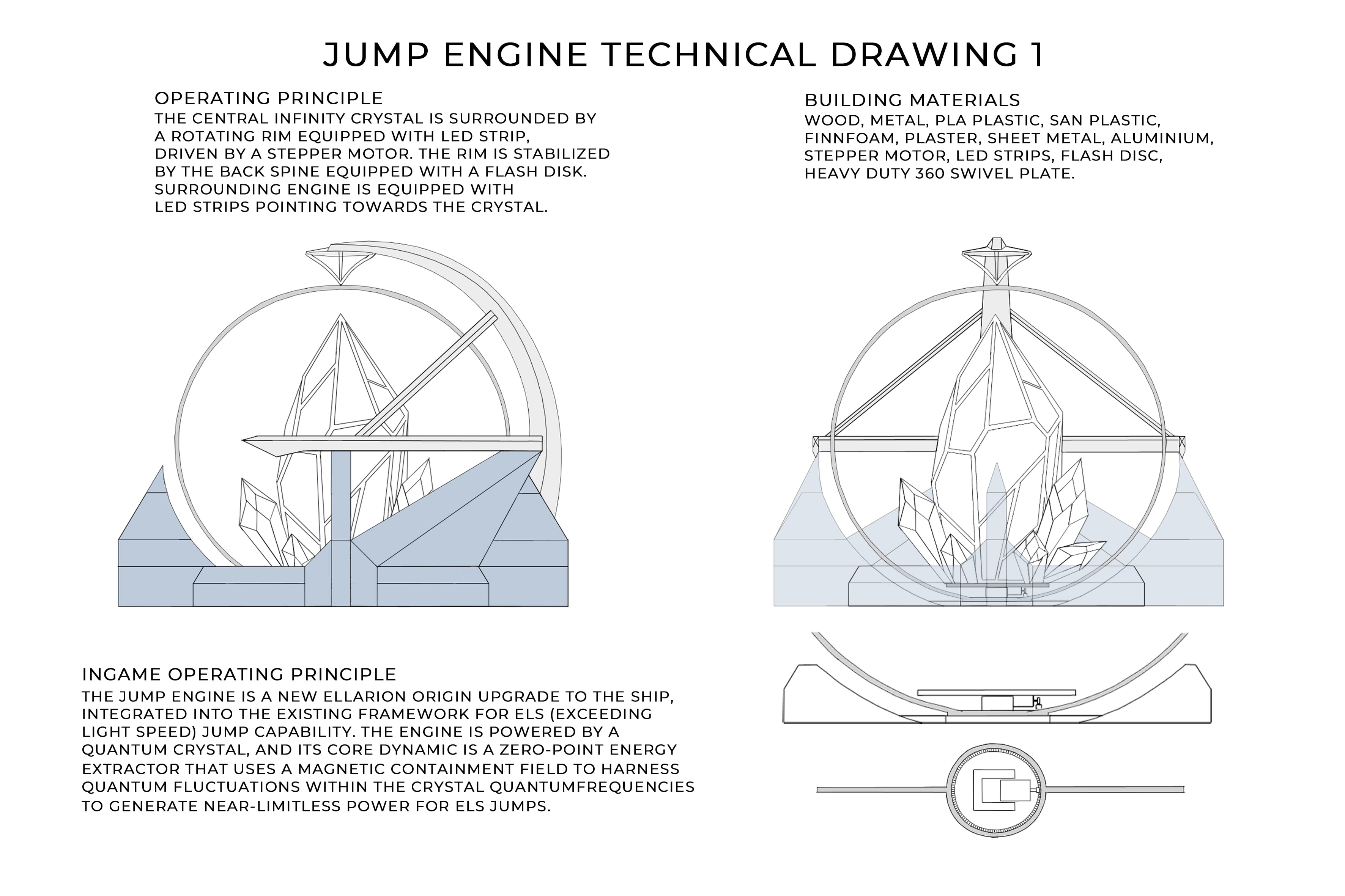
2026 design: Jump engine, part of the engine’s internal logic
Design process - From a building architecture to a vessel layout
Before a player ever steps inside the world of Odysseus, that world first has to be imagined, written, designed and built. And ultimately, it has to function physically. Spatial design is where fiction negotiates with reality. It is the phase where a spaceship must fit inside a building that was never meant to hold one.
Over the past months, I have been evaluating and comparing potential locations, calculating blueprints, measuring floor plans, converting architectural plans into spatial layouts that support gameplay, drawing technical drawings to ensure the design can be realistically built, as well as 3D spatial models to test proportions, sightlines and flow, and to visualize how the spaces will function in practice. Within the plans, I design out-of-game logistics pathways hidden inside the layouts to protect immersion. Also integrated technical system, including spaces for speakers, subwoofers and concealed equipment within the set, as well as cable routes connecting the ship to the out-of-game control room from which the experience is operated.
On paper, square meters can look generous. In reality, ceiling heights, structural geometry, load-bearing elements, fire safety regulations, escape routes and logistics access begin to reshape the vision. Every building comes with its own constraints and possibilities. It must function as a safe and sustainable venue, and these realities shape the final layout. Sometimes, entire planned areas must be redesigned or removed to preserve spatial coherence, safety and operational functionality. Spatial design is where creativity meets physics.
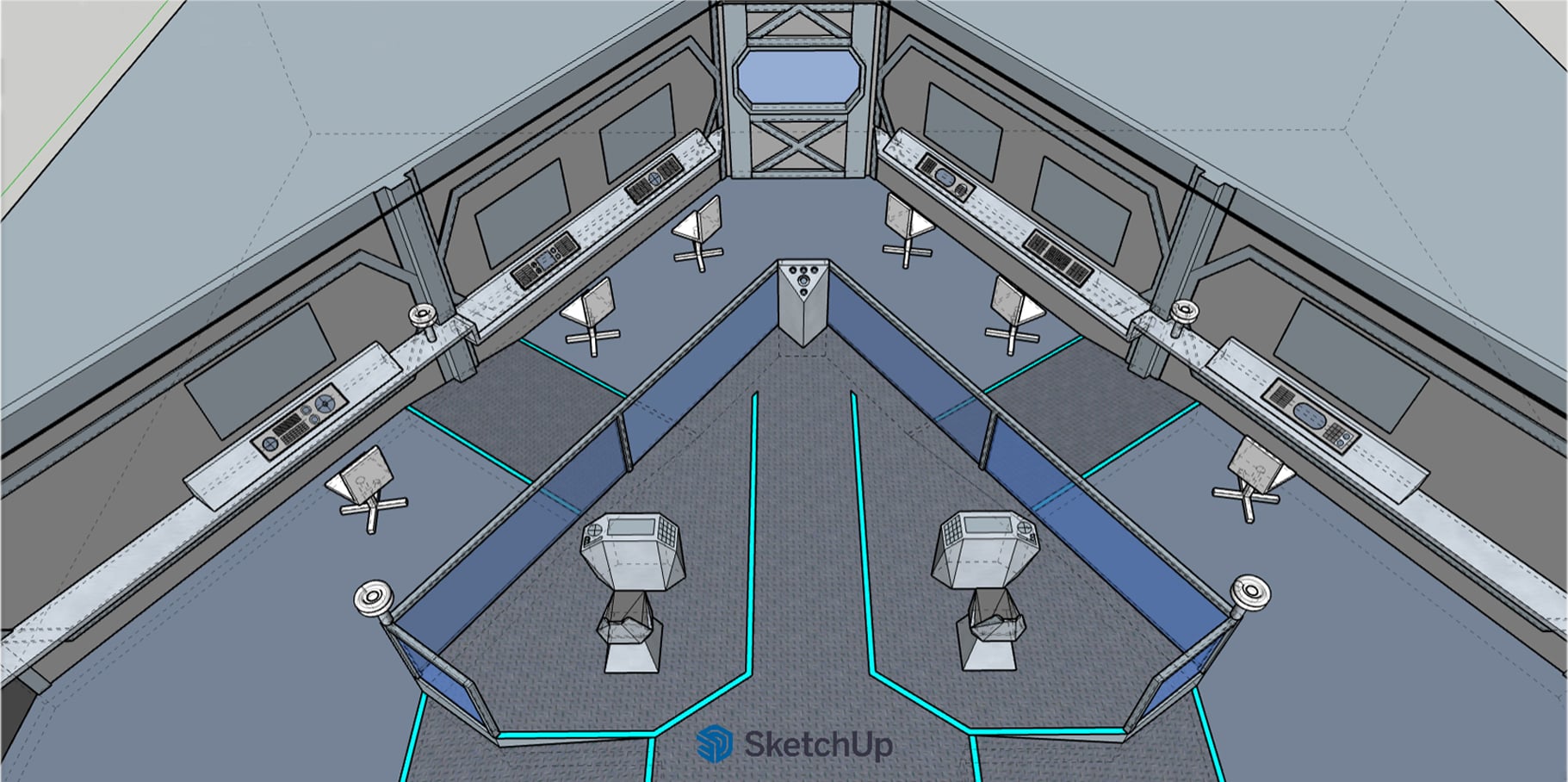
2026 design: Command Bridge
Player flow routes are planned not only for accessibility and safety, but also for gameplay and emotional rhythm: where players gather or disperse, where tension rises, and where silence settles. In spatial design, I don’t simply assign functions to rooms; I design movement, perspective and atmosphere.
A narrow corridor can create urgency, fear or claustrophobia.
A low ceiling can intensify intimacy, intensity or anxiety.
A large open volume and floor platforms can elevate hierarchy and spectacle.
Color palettes and lighting play an equally important role in shaping these emotional responses. As spatial designer and scenographer, I work with the overall atmospheric direction of each area, including its color language and light mood, while our lighting designer develops the technical solutions and detailed implementation. Atmosphere is also built through sound and visual identity. Our sound designer shapes the acoustic world of the ship, and our graphic designer defines its visual language. Together, their work turns structure into a fully immersive experience.
Bringing all these layers together requires careful planning and constant refinement. Designing an immersive spaceship environment is both a creative and a technical process. This is also why my callsign in the team is Prototype, it feels fitting for a process built around testing, building, rebuilding and improving from previous iterations. The goal is not to decorate a building to resemble a spaceship. The goal is to make the architecture itself feel intentional. When spatial design works, players do not notice constraints. They do not see compromises. They feel continuity and internal logic.
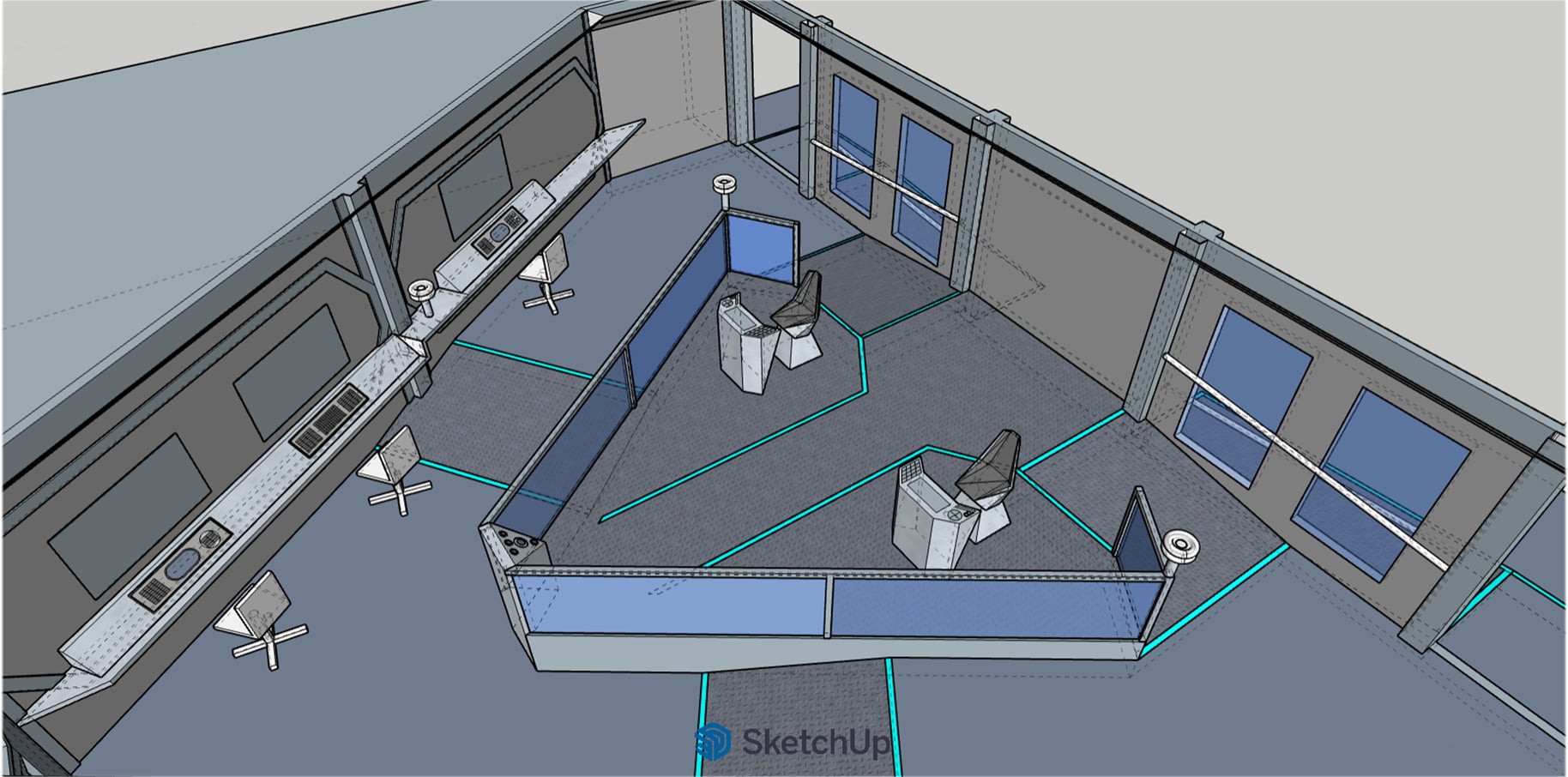
2026 design: Command Bridge, ramps & railings
Accessibility and accommodation
Accessibility is one of our core values. Minimizing visible spatial constraints and compromises includes taking into account different accessibility measures without letting them affect people’s immersion. Ramps and railings are a part of the vessel’s flow, style and visuals instead of an addition on the side. If the vessel happens to be in a two-story building, we will ensure access via an elevator or a stairlift. Strobe lighting and extremely bright flashing lights have been minimal or nonexistent in previous games and are generally avoided in the design. In areas with loud sounds such as the Engine Room, there are ear protectors available, as well as helmets, knee protectors and work gloves for engineer work and play. We will also do our best in taking into account people’s food restrictions and allergies during the event.
Accessibility is also something I take personally in my design work. In previous projects this has meant paying attention to things like floor textures, smells and moving elements. In one project, this included a real forest smell from spruce and pine branches, and a boat on wheels that visitors could travel in. These kinds of things can help different people navigate and experience the environment in their own ways. One of these designs once received particularly warm feedback from a deafblind visitor, which has stayed with me as a reminder of how meaningful these details can be.
Off-game areas will have a player-safety and quiet areas for decompressing before, after and during a run. The off-game area will have a small merch store where also earplugs, some sanitary items etc. will be available. The area will possibly also have a small kitchen for the players to use for their own snacks and foods they might have brought with them. We also aim to have a location with a grocery store within a reasonable distance.
The sleeping areas used a hotbunk system in previous iterations of the ship. In the permanent location we aim to avoid hotbunking if possible, although this ultimately depends on the location and the space available. Depending on the building, sleeping areas may take a few different forms. In smaller rooms there may be two bunk beds, creating four-person cabins. In larger rooms multiple bunk beds can be placed side by side, with built walls between them to create a capsule-hotel-style sense of privacy. In some locations, if the crowdfunding allows, fully capsule hotel-style sleeping pods may also be possible.
In every scenario, I will ensure that some beds are accessible, with enough space beside them for a wheelchair or a nightstand for any equipment someone may need during sleep. Electrical sockets will also be available in the sleeping areas, as well as a locker for everyone for their personal belongings. It is also not mandatory to sleep in location during the event, and we will be looking for co-operation possibilities with nearby hotels, for visitors who prefer this option.
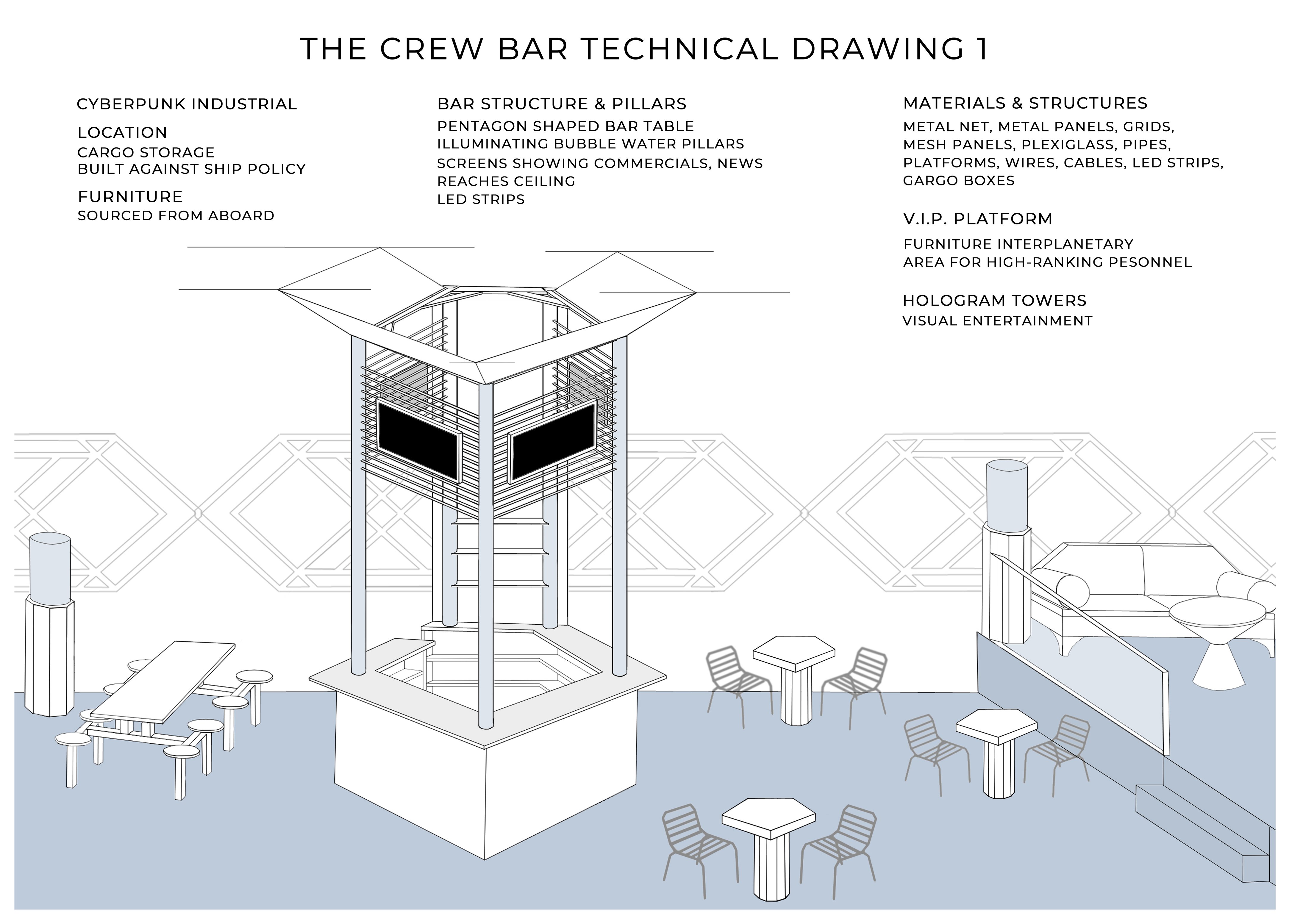
2026 design: Crew Bar
When the vessel is built - upkeeping and upgrading
Good spatial design does not end when the venue is built. The venue also has to endure in use, adapt over time, and continue supporting both immersion and player wellbeing from run to run.
Once the spaceship is built, my work does not end. It shifts, and I will be around. My responsibility continues through spatial maintenance, development and long-term sustainability planning. This includes creating maintenance schedules for sets and integrated technical systems, monitoring structural wear and safety compliance, conducting inspections, updating spatial documentation and plans, and planning repairs or upgrades as needed. Spaces must also evolve alongside gameplay, requiring adjustments and refinements between runs. The ship is not a static installation; it is a living environment that requires continuous spatial oversight to remain safe, immersive and functional over time.
Designing a physical spaceship is a slow, careful process. It requires accepting limitations without surrendering vision. It requires recalculating, redrawing and sometimes letting go of ideas in order to protect the integrity of the whole. With every iteration, or prototype, the world inside a building becomes clearer. And slowly, you start to forget that you’re standing inside a building at all.
Crita
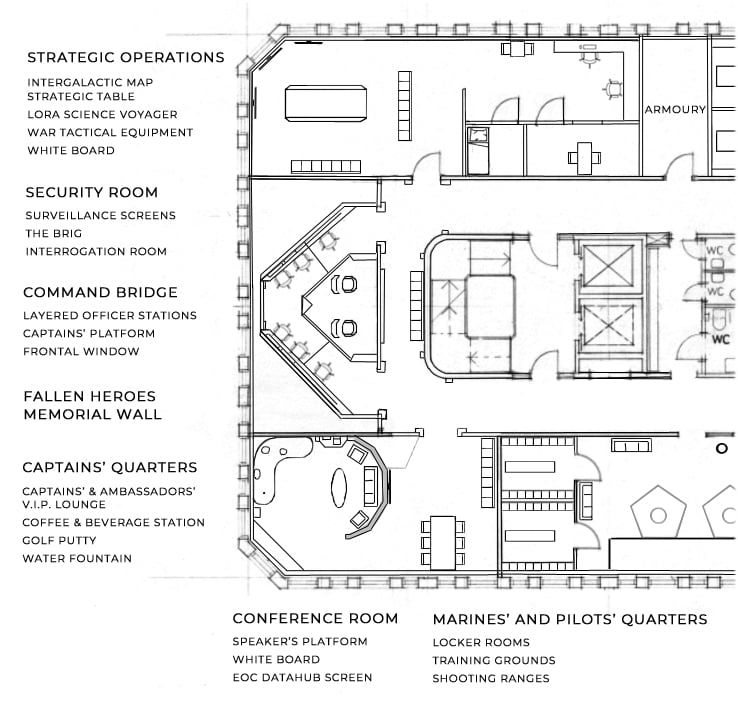
2026 Floorplan sketch, final layout depends on the chosen venue